
MacBook Repair Kuwait
Chip-level motherboard repair, USB-C power IC replacement, and liquid damage recovery — without Apple's full board-swap and data-loss policy.Your MacBook won't turn on, a spilled drink has just hit the keyboard, or neither Thunderbolt port will charge it anymore — and an Apple Authorized Service Provider has quoted a full motherboard replacement that costs hundreds of KWD and, on most Apple Silicon models, means starting over with zero access to your original files. That last part isn't a scare tactic — it's how the hardware works: on M1/M2/M3 MacBooks, storage is soldered directly to the board and encrypted against that specific board's Secure Enclave, so a swapped board is a genuinely different machine as far as your data is concerned. We take the other path. Using thermal imaging and a multimeter, we trace the fault to the exact failed component — a shorted MOSFET, a blown power IC, a corroded trace — and repair that one point via micro-soldering, on your original board. Your SSD, your Secure Enclave, and your data stay exactly where they were.
Built for: Creative professionals, developers, students, and business professionals who've been quoted an expensive board-swap by Apple or a reseller and need the original motherboard — and the data on it — recovered rather than replaced.
Repair levelchip level
Typical turnaround24-48 Hours
Warranty30 Days
PricingFrom 25 KWD — free diagnostic first
Why Choose Us
Chip-Level Motherboard Repair
We trace the fault to the specific failed component — a MOSFET, a power IC, a corroded trace — and repair it directly, instead of defaulting to a full board swap.
Data Preserved By Design
Because we repair your original board rather than replacing it, your SSD and Secure Enclave never change — a real distinction on Apple Silicon models, where a swapped board means the storage encryption no longer matches.
USB-C Power IC Specialists
Charging and port failures are among the most common MacBook faults we see, and are frequently a single failed IC rather than a reason to replace the board.
Liquid Damage Ultrasonic Cleaning
The board is fully stripped and run through an industrial ultrasonic cleaner to remove corrosion at a microscopic level before we assess what, if anything, needs replacing.
Free Diagnostic Before Any Quote
Thermal imaging and multimeter tracing happen before you're quoted anything — you know the actual fault, not a guess based on symptoms alone.
ESD-Safe Laboratory
All micro-soldering and board work is performed on grounded, static-controlled workstations in our Hawalli lab.
Free Pickup & Delivery, Kuwait-Wide
Collected from and returned to your home or office anywhere in Kuwait, at no extra cost.
No Fix, No Fee
If we can't repair it after diagnosis, you pay nothing — not even for the diagnostic.
Service Capabilities
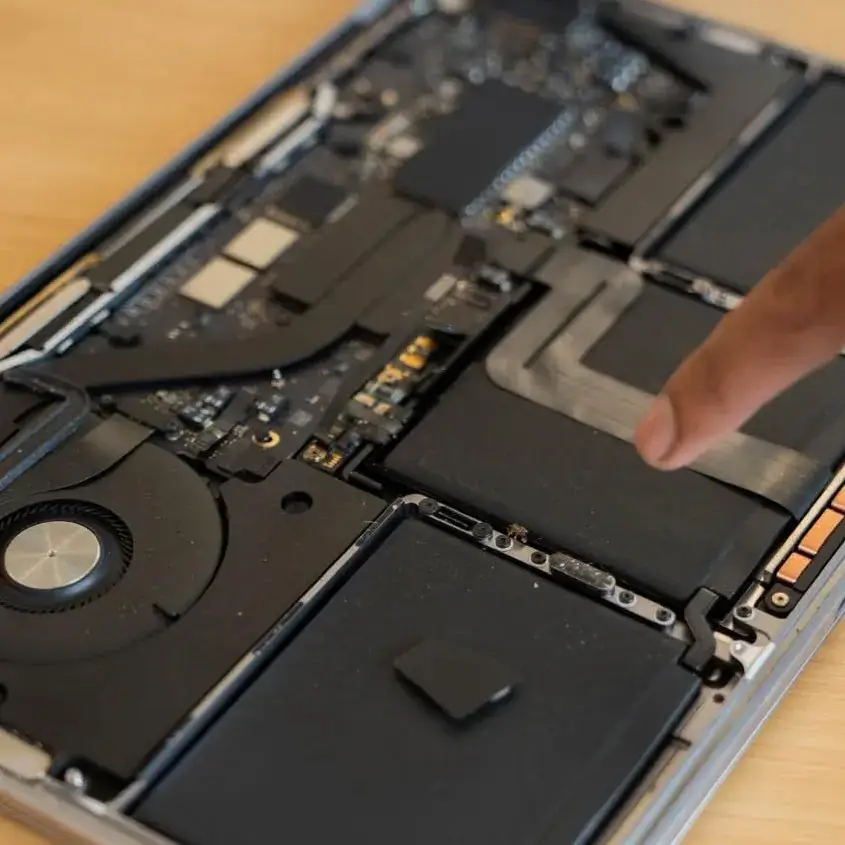
Component-level motherboard and fan repair — replacing the exact failed chip rather than the whole board.
- Motherboard Micro-Soldering
- USB-C Power IC Replacement
- Liquid Damage Ultrasonic Cleaning
- Data-Safe Board-Level Repair (Apple Silicon & Intel)
- MacBook Screen Replacement
- MacBook Battery Replacement
- Keyboard Replacement (Butterfly & Magic Keyboard)
- Trackpad & Taptic Engine Repair
- Speaker & Audio IC Repair
- WiFi / Bluetooth Module Replacement
- Free Pick & Drop
- 30-Day Warranty
Devices We Cover
MacBook Air (M1, M2, M3)MacBook Pro 13" (Intel & M-series)MacBook Pro 14" (M1 Pro/Max, M2 Pro/Max, M3 Pro/Max)MacBook Pro 16" (Intel & M-series)Intel MacBooks (2015 and later)
Brands We Service
MacBook AirMacBook Pro 13"MacBook Pro 14"MacBook Pro 16"
Common Problems We Fix
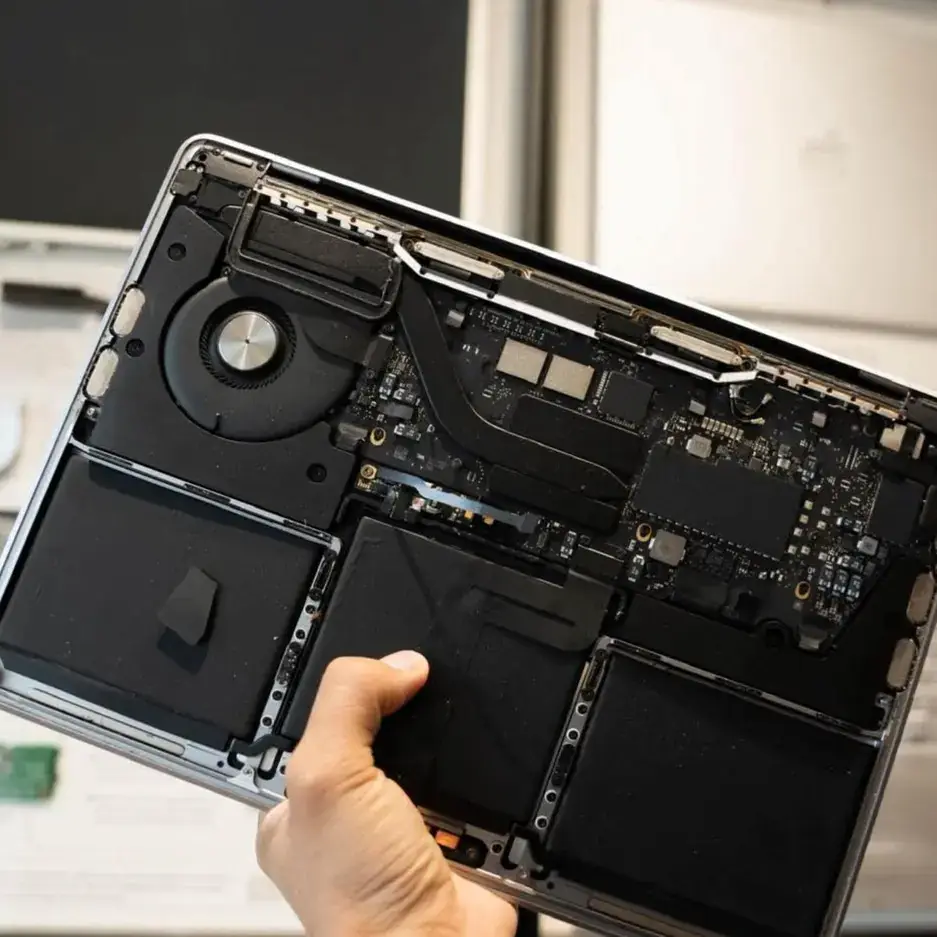
A technician running board-level diagnostics on an opened MacBook to isolate the failed component.
No Power / Completely Dead Device
criticalNo charging light, no fan spin, no response to the power button. Usually a shorted input MOSFET or a blown main power rail (PPBUS_G3H and similar) rather than a dead motherboard outright — we trace it with a multimeter before assuming the worst.
Liquid Spill / Water Damage
criticalCoffee, water, or juice spilled on the keyboard creates conductive bridges across the board and can short components within hours as sugars and acids corrode copper traces. Power off immediately and don't try to turn it on to "check" it — that's what actually completes the short in most cases we see.
USB-C Port Not Charging or Not Recognized
highNeither Thunderbolt port charges the machine or recognizes accessories. Most commonly a failed power negotiation IC on the board — the physical port itself is rarely the actual fault, which is why replacing just the port connector often doesn't fix it.
Screen Flickering or Backlight Failure
mediumCan be a damaged display cable (common near the hinge on frequently opened/closed lids), a failing backlight driver, or — less often — a GPU-related fault on Intel models. We isolate which before quoting a screen replacement.
Keyboard Keys Not Responding or Sticking
mediumOn 2016-2019 butterfly-mechanism keyboards, dust ingress under individual keys is a well-known failure point. On Magic Keyboard models (2020+), it's more often a ribbon cable or controller issue. We diagnose which mechanism is involved before replacing anything.
Trackpad Unresponsive or Not Clicking
mediumForce Touch trackpads use a Taptic Engine to simulate a click rather than a physical switch — when that fails, the trackpad can still move the cursor but stop registering clicks entirely, which is a Taptic Engine fault, not a full trackpad replacement in most cases.
Stuck on Apple Logo / Won't Boot Past Startup
highCan range from a corrupted macOS installation (software-level, no hardware repair needed) to a failing SSD controller or RAM fault on the board. We check software recovery options first before assuming a hardware repair is required.
Random Restarts / Kernel Panics
highIntermittent, unpredictable restarts under normal use point toward a power delivery instability or a marginal RAM/storage connection rather than a software bug, especially if they happen regardless of which apps are running.
No Sound or Distorted Audio
lowUsually a failed audio IC or a damaged speaker driver rather than a software setting — worth a diagnostic if a system reset hasn't resolved it.
WiFi or Bluetooth Not Working
lowCan be a wireless card fault, a damaged antenna connection (common after screen or top-case work by other shops), or a driver-level issue on older macOS installs.
Swollen Battery Lifting the Trackpad
criticalA visibly raised or uneven trackpad is frequently a swollen battery underneath it — a genuine safety issue, not cosmetic. Stop using the device and see our dedicated battery replacement service for safe removal.
Overheating or Constant Fan Noise
mediumMore common on Intel MacBook Pro models under sustained loads (video export, compiling) than on Apple Silicon, but dust-clogged fans and degraded thermal paste affect both — we check airflow and thermal material condition as part of every diagnostic.
Dead MacBook With Important Data Still On It
criticalBecause storage is soldered and encrypted to the board on most modern MacBooks, a completely dead machine with unsaved data is precisely the scenario where board-swap (Apple's standard fix) permanently loses access to your files, while board-level component repair is often the only path that keeps them recoverable.
Typical Results
The outcomes below describe typical results for these repair categories, not a guarantee for any specific device — every repair is quoted after its own diagnostic.
Board Recovery Rate
The majority of motherboards referred to us as "needs full replacement" are repairable at component level once the fault is traced to its actual source.
Data Preservation
Because the original board is repaired rather than swapped, the original SSD and Secure Enclave remain untouched in the large majority of repairs — data stays accessible without a separate recovery step.
Liquid Damage Cases
Boards brought in within 24-48 hours of a spill, without being powered on again after the incident, have meaningfully better recovery outcomes than those that were repeatedly tested first.
Cost vs. Board-Swap Quotes
Component-level repair typically costs a fraction of an out-of-warranty full motherboard replacement quote.
Representative Repair Scenarios
These are representative repair scenarios illustrating common fault categories we service, not records of a specific named customer.
MacBook Pro: Neither Thunderbolt Port Would Charge
- Symptoms
- The laptop wouldn't charge from either USB-C port, tested across three different chargers and cables.
- Diagnosis
- Multimeter testing under load isolated the fault to the board's power negotiation IC, not the physical ports or the chargers.
- Outcome
- Both ports charged normally and were verified across multiple chargers before return.
MacBook Air: Spill Recovered With No Data Loss
- Symptoms
- Liquid was spilled on the keyboard; the device was powered off immediately and brought in the same day without being tested again.
- Diagnosis
- Because power was cut immediately and the device wasn't powered back on, ultrasonic cleaning found minimal corrosion and no shorted components.
- Outcome
- The MacBook returned to full function with no data loss and no chip-level repair required — illustrating why immediate power-off matters more than any repair technique afterward.
MacBook Pro: Data Recovered From a Board Apple Called Unfixable
- Symptoms
- The MacBook was completely dead with no display; Apple quoted a full motherboard replacement with total data loss, since the Apple Silicon storage encryption is tied to the original board's Secure Enclave.
- Diagnosis
- Thermal imaging under a safe test voltage located a single shorted component on the main power rail.
- Outcome
- The original SSD and Secure Enclave were never touched — all data remained accessible once the board powered on again.
Our Repair Process
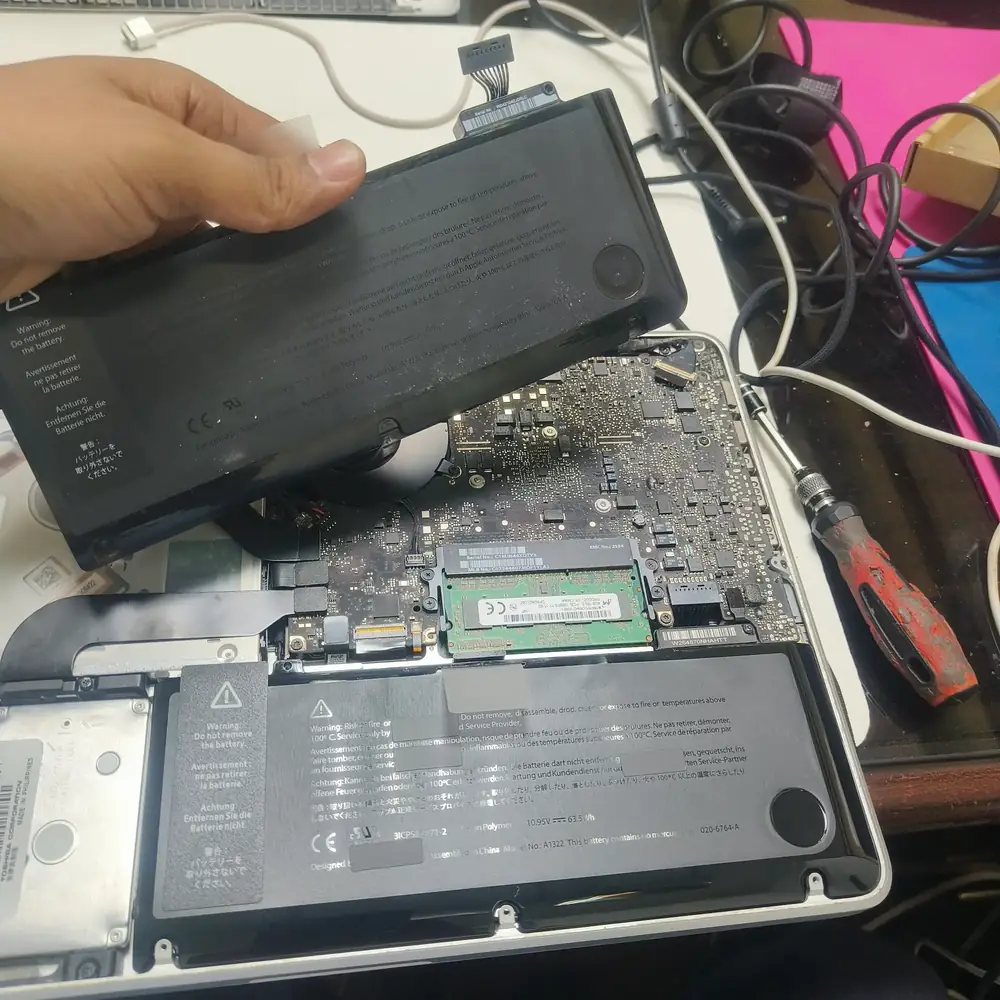
A swollen MacBook battery safely removed during teardown before board-level repair begins.
1
Free Pickup
We collect your MacBook from your home or office anywhere in Kuwait.
2
Thermal Imaging & Multimeter Diagnostic
We trace the fault to the exact component — a shorted MOSFET, a blown power IC, a corroded trace — rather than assuming the whole board needs replacing.
3
Confirm the Fault & Quote
You get a written explanation of what's actually wrong and an itemized quote before any work starts.
4
Micro-Soldering Repair in an ESD-Safe Lab
The failed component is replaced or the board is ultrasonically cleaned for liquid damage, on grounded, static-controlled workstations.
5
Full-Load Stress Testing
The board is stress-tested under sustained load to confirm the repair holds before reassembly.
6
Return with 30-Day Warranty
Your MacBook is delivered back with your original SSD, Secure Enclave, and data untouched.
What We Check
- Power rail voltage tracing
- USB-C power IC diagnostics
- Battery health & charging circuit test
- Liquid damage / corrosion inspection under magnification
- Display & backlight circuit test
- Keyboard & trackpad function test
- Speaker & microphone test
- WiFi / Bluetooth module test
- Thermal imaging under sustained load
Frequently Asked Questions
Related Repair Resources
Explore the closest repair services, troubleshooting pages, brand specialists and practical guides for this type of fault.
Related services
Troubleshooting pages
First-party repair evidenceMacBook Liquid-Damage Case Study — Salmiya
Service Areas in Kuwait
Ready to fix your device?
Our technicians are ready to trace the fault. Send us your symptoms via WhatsApp for a fast, free estimate.
Message on WhatsApp
No Fix, No Fee Guarantee