
Motherboard Repair Kuwait
Chip-level power rail tracing, MOSFET replacement, and BGA rework — for boards other shops call "beyond repair."A laptop that's completely dead, one that shuts off randomly during normal use, or one a retail shop already quoted a "full motherboard replacement" for — these are the cases where component-level repair actually matters most, because a motherboard replacement usually costs more than the laptop is worth once you're past the second or third year of ownership. Most repair counters carry one tool for a dead board: swap the whole thing. We carry a multimeter, a thermal camera, and boardview schematics, and use them to trace the fault to the single component that actually failed — a shorted MOSFET, a blown fuse, a degraded capacitor, a corroded trace from an old spill — and repair that one point instead. The rest of the board, and anything soldered to it, stays exactly as it was.
Built for: Users with completely dead or liquid-damaged devices who have been told by standard retail shops that their laptop is "unfixable" and want to save up to 80% versus a full board replacement.
Why Choose Us
We Trace the Fault Before We Quote Anything
Multimeter testing and thermal imaging identify the actual failed component before any repair or replacement is discussed — not a guess based on symptoms.
Component-Level Repair, Not Board Swap
A shorted MOSFET or a blown fuse is a single-component fix. Most shops treat it as a reason to replace the entire board — we treat it as what it is.
BGA Rework Capability
Chip-level faults — including GPU, chipset, and memory controller issues — are reworked directly under magnification with controlled reflow, rather than declared unfixable.
Data Stays on the Original Board
Because we repair rather than replace, anything soldered to the board — storage, in particular on Apple Silicon and many modern ultrabooks — is never disturbed.
ESD-Safe Laboratory
All board-level work happens on grounded, static-controlled workstations in our Hawalli lab, where a single uncontrolled static discharge can be the difference between a repairable board and a dead one.
Kuwait Climate Expertise
Sustained heat accelerates capacitor degradation and solder joint fatigue well beyond what manufacturer specs assume — we see the resulting failure patterns daily and know what to check for.
Free Pickup & Delivery, Kuwait-Wide
Full laptops or desktop towers collected from and returned to your home or office anywhere in Kuwait, at no extra cost.
No Fix, No Fee
If the board is genuinely beyond economical repair after diagnosis, you pay nothing — not even for the diagnostic.
Service Capabilities
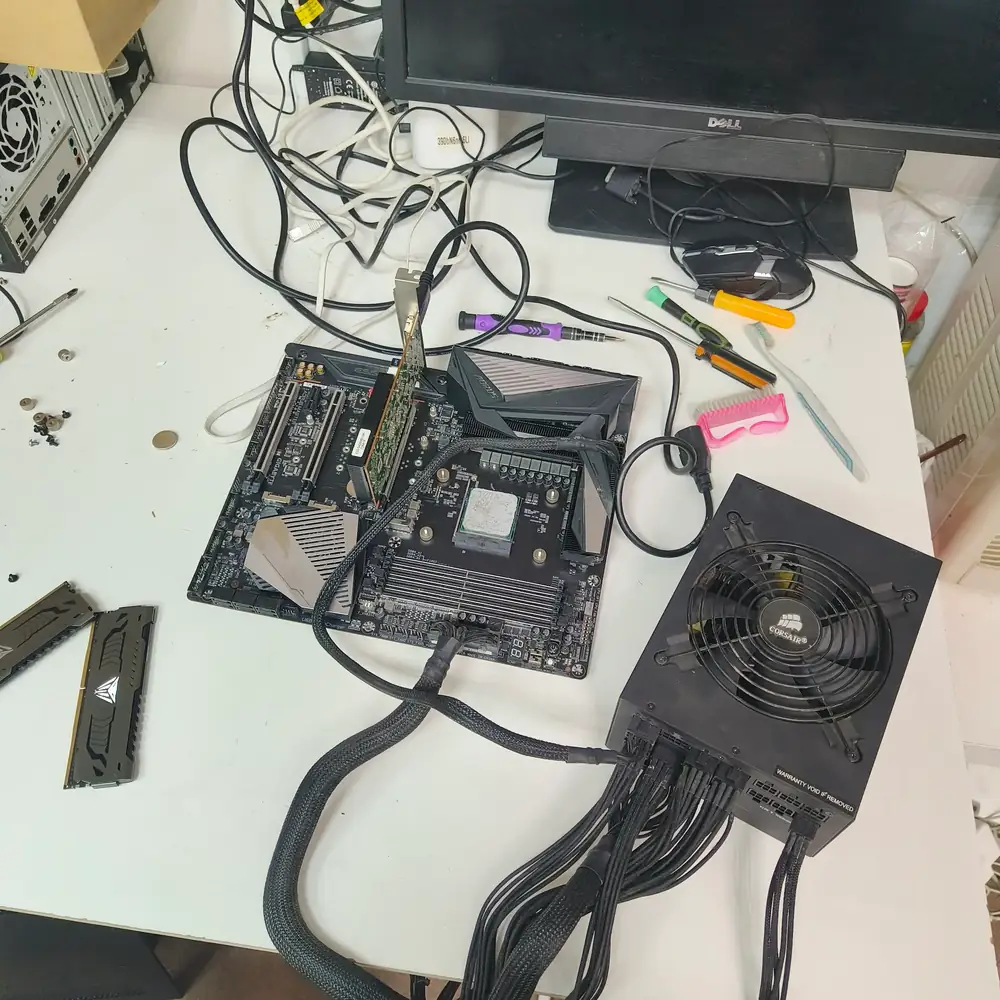
Breadboarding a motherboard outside its case to isolate a fault at the component level.
- Power Rail Voltage Tracing
- MOSFET & Power IC Replacement
- BGA Rework & Chip Reballing
- Liquid Damage Ultrasonic Cleaning
- Blown Fuse Diagnosis & Replacement
- Capacitor Replacement
- BIOS Chip Reflashing
- Boardview-Guided Fault Tracing
- Free Pick & Drop
- 30-Day Warranty
Devices We Cover
Brands We Service
Common Problems We Fix
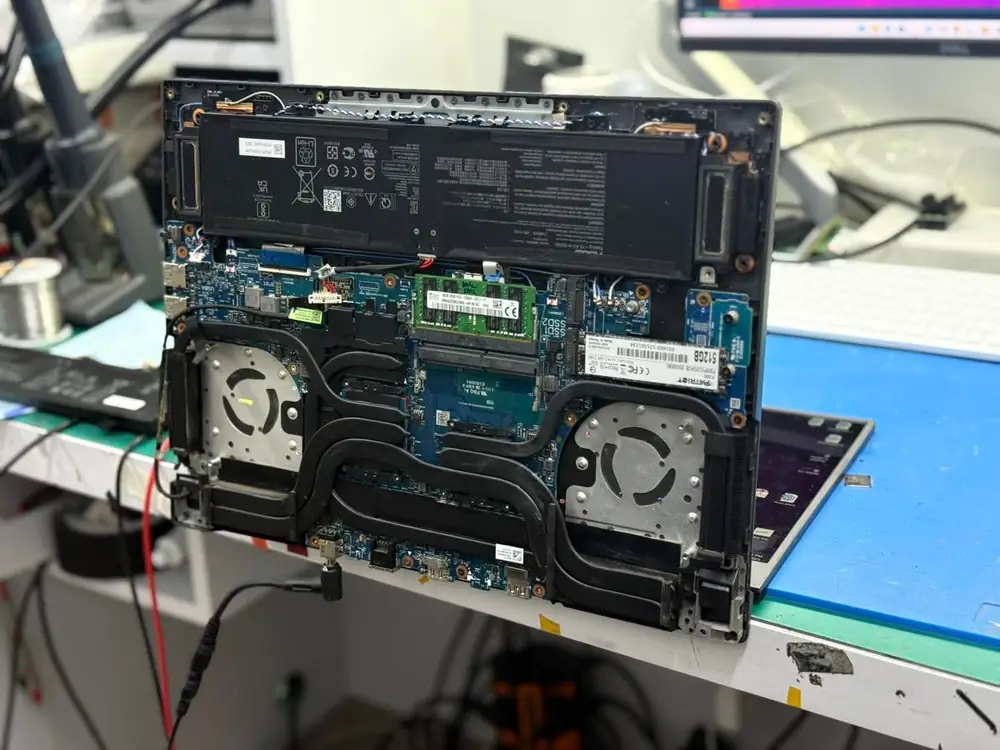
A motherboard under diagnostic testing on the bench to trace a failed power rail before any part is replaced.
Dead Laptop / No Power At All
criticalNo lights, no fan spin, no response to the power button. Most often an input MOSFET short or a blown fuse on the main power rail — a single-component fault we trace with a multimeter before assuming the board is a total loss.
Liquid-Damaged Motherboard
criticalSpilled liquid creates conductive bridges across the board and corrodes copper traces within hours. We ultrasonically clean the board and replace only the components the short actually damaged.
Random Shutdowns or Instability
highUnpredictable restarts regardless of workload usually point to a degrading power rail or a capacitor that can no longer hold a stable charge, not a software fault.
VRM Failure Under Load
highThe system shuts off specifically under heavy CPU/GPU load — a voltage regulation module component has degraded to the point it can't sustain power delivery at higher draw.
Won't POST / No Display, No Boot
criticalFans and lights come on but nothing progresses past power-on. Can be a corrupted BIOS chip, a dislodged component from a previous repair elsewhere, or a failed RAM/chipset connection — we isolate which with boardview diagnostics.
Bulging or Leaking Capacitors
mediumVisibly domed or leaking electrolytic capacitors are a heat-accelerated failure mode we see often in Kuwait — replacing them before they fail completely prevents a simple fix from becoming a dead board.
Charging Port Torn From the Board
highRepeated stress on the charging cable can rip the DC jack or USB-C port off its solder pads entirely. We reattach and reinforce the connection via micro-soldering.
Corrupted BIOS / Failed Firmware Update
criticalA power interruption mid-update or a bad flash can leave a board unable to POST at all. Where a CMOS reset doesn't recover it, we reflash the BIOS chip directly with an external programmer.
Intermittently Powers On, Then Stops
mediumA board that sometimes boots and sometimes doesn't often has a marginal, partially-failed component or a cracked solder joint under thermal stress — harder to catch than a clean dead-short, but traceable under load testing.
Typical Results
The outcomes below describe typical results for this repair category, not a guarantee for any specific board — every repair is quoted after its own diagnostic.
Board Recovery Rate
The majority of boards referred to us as "needs full replacement" are repairable at component level once the fault is traced to its actual source.
Cost vs. Full Replacement
Component-level motherboard repair typically costs a fraction of a full board replacement quote — often up to 80% less.
Data Preservation
Because the original board is repaired rather than swapped, anything soldered to it — including storage on many modern ultrabooks and MacBooks — remains untouched.
Liquid Damage Cases
Boards brought in promptly after a spill, without being powered back on, have meaningfully better recovery outcomes than those tested repeatedly first.
Representative Repair Scenarios
These are representative repair scenarios illustrating common fault categories we service, not records of a specific named customer.
Dell Laptop: Completely Dead, Quoted a Full Board Replacement
- Symptoms
- No power lights, no fan spin, no response to the power button — a retail shop quoted a full motherboard replacement.
- Diagnosis
- Multimeter testing traced a dead short to a single input MOSFET on the main power rail.
- Outcome
- The laptop powered on and passed full-load stress testing, at a fraction of the quoted board-replacement cost.
HP Laptop: Coffee Spill, Powered Off Immediately
- Symptoms
- Coffee was spilled on the keyboard; the laptop was powered off right away and brought in the same day.
- Diagnosis
- Ultrasonic cleaning revealed light corrosion with no shorted components, since power was cut before a short could develop.
- Outcome
- The laptop returned to full function with no data loss, illustrating why an immediate power-off matters more than any repair technique afterward.
Windows Laptop: Random Shutdowns During Normal Use
- Symptoms
- The laptop would shut off unpredictably, sometimes minutes after boot, sometimes hours in, with no pattern tied to any specific app.
- Diagnosis
- Load testing identified a degraded capacitor on the power delivery circuit no longer holding a stable charge under minor voltage fluctuation.
- Outcome
- The laptop ran stable through extended use testing with no further shutdowns.
Our Repair Process
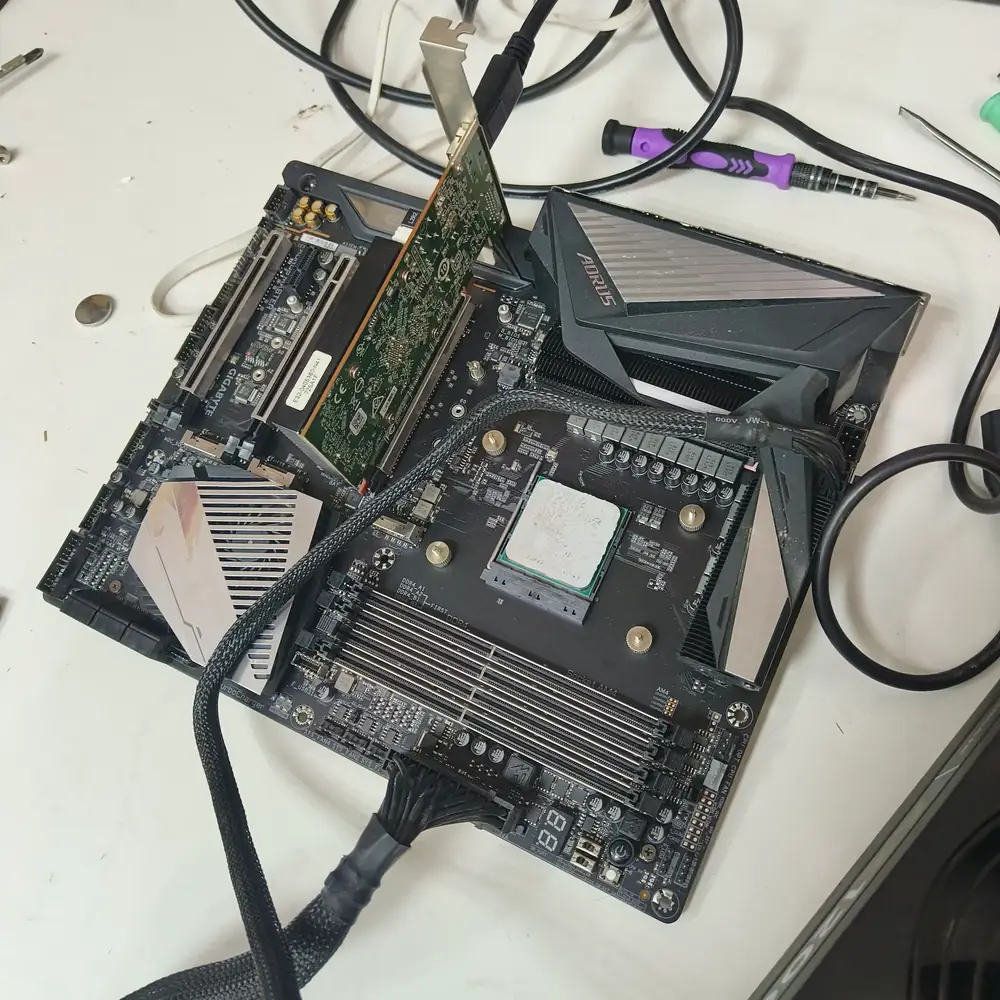
Inspecting thermal paste and chip contacts as part of the board-level repair process.
Free Pickup
We collect the device from your home or office anywhere in Kuwait.
Multimeter & Thermal Imaging Diagnostic
We trace the fault to the exact failed component rather than assuming the whole board needs replacing.
Confirm the Fault & Quote
You receive a written explanation of what's actually wrong and an itemized quote before any work starts.
Micro-Soldering & BGA Rework in an ESD-Safe Lab
The failed component is replaced, or the board is ultrasonically cleaned for liquid damage, on grounded, static-controlled workstations.
Full-Load Stress Testing
The board is stress-tested under sustained load to confirm the repair holds before reassembly.
Return with 30-Day Warranty
Your device is delivered back with the original board repaired, not swapped.
What We Check
- Power rail voltage tracing
- Input MOSFET and power IC test
- Capacitor condition inspection
- Liquid damage / corrosion inspection under magnification
- BIOS chip and firmware verification
- Charging port solder joint integrity
- Boardview-guided component testing
- Full-load stress test after repair
Frequently Asked Questions
Related Repair Resources
Explore the closest repair services, troubleshooting pages, brand specialists and practical guides for this type of fault.
Related services
Troubleshooting pages
Brand specialists
Where We Handle This Repair
These are the Kuwait service areas most directly connected to this repair type. Pickup is arranged through KCROC rather than requiring a walk-in visit.
Service Areas in Kuwait
Ready to fix your device?
Our technicians are ready to trace the fault. Send us your symptoms via WhatsApp for a fast, free estimate.